
APA Ethical Principles — Official Full Visual Infographic
High-resolution study sheet and visual guide
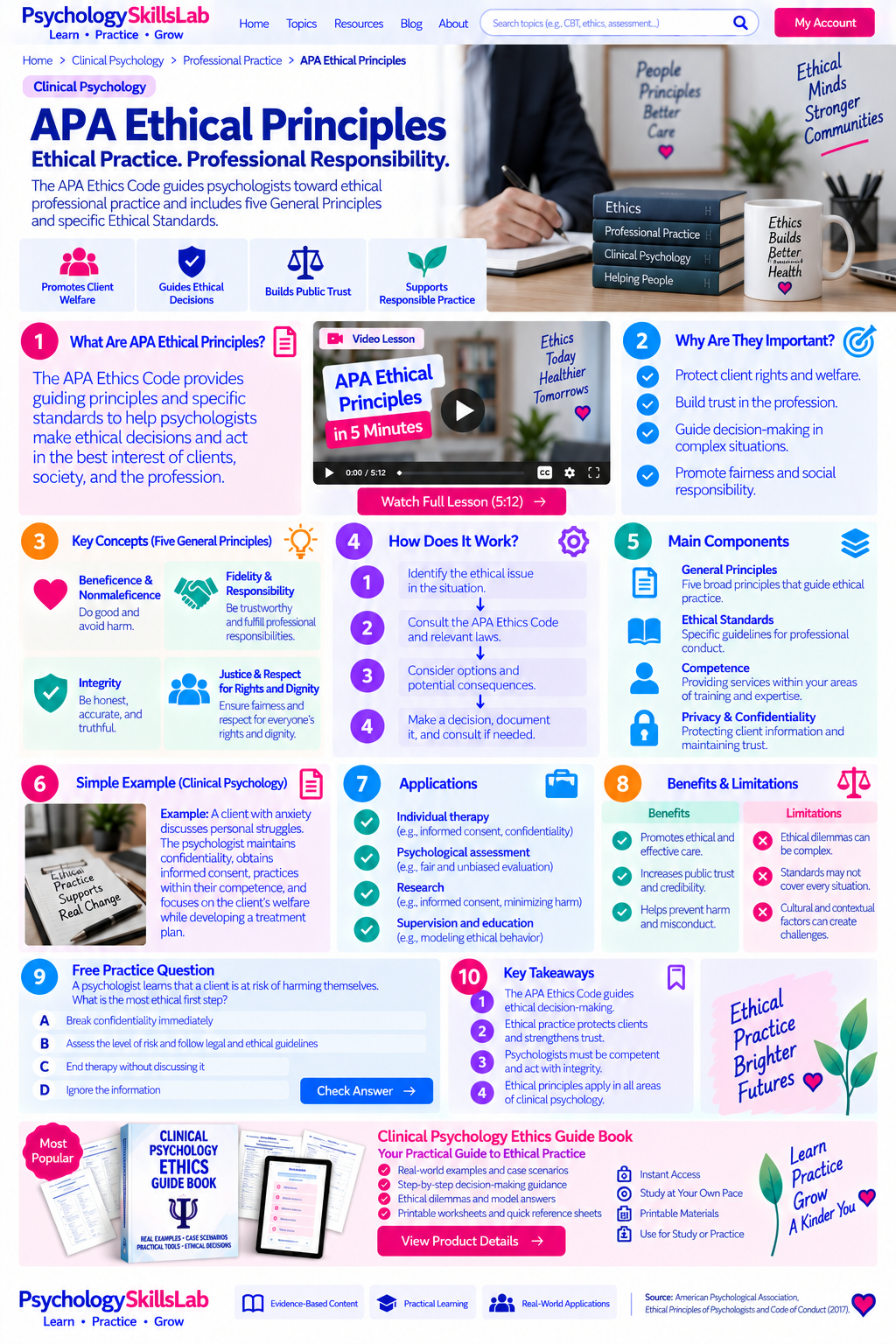
APA Ethical Principles
Ethical Practice. Professional Responsibility.
The American Psychological Association (APA) Ethics Code provides the guiding ethical blueprint for psychologists, establishing five overarching aspirational General Principles and ten enforceable Ethical Standards.

"People Principles Better Care."
What Are APA Ethical Principles?
The APA Ethical Principles of Psychologists and Code of Conduct is the definitive ethical benchmark. It articulates high-minded professional ideals while outlining enforceable conduct standards to protect clients, research subjects, and students.
- check_circle General Principles (A through E) are aspirational goals that inspire the highest ethical ideals of psychology.
- check_circle Ethical Standards are enforceable rules subject to state licensing board sanctions and disciplinary action.
- check_circle Covers competence, privacy, assessment, therapy, advertising, education, and scientific research.
APA Ethical Principles in 5 Minutes
Ethics Today • Healthier Tomorrows ❤️
Why Are They Important?
- check_circle Protects the civil rights, welfare, and safety of clients across all settings.
- check_circle Solidifies public trust and institutional credibility in psychological science.
- check_circle Provides definitive frameworks to navigate competing legal and moral demands.
- check_circle Promotes social responsibility, scientific integrity, and human equity.
Five General Principles
Principle A: Beneficence & Nonmaleficence
Striving to benefit those with whom they work and taking care to do no harm.
Principle B: Fidelity & Responsibility
Establishing relationships of trust and upholding professional obligations.
Principle C: Integrity
Promoting accuracy, honesty, and truthfulness in science, teaching, and practice.
Principle D & E: Justice & Respect
Ensuring fairness, equal access, and respecting autonomy and human dignity.
How Does It Work?
Identify the ethical principle or standard at play in a clinical case.
Consult the relevant sections of the APA Ethics Code and state licensing law.
Assess potential conflicts of interest, harm risks, and client needs.
Formulate a justifiable course of action, consult peers, and document rationale.
Main Components
5 General Principles
Aspirational goals: Beneficence, Fidelity, Integrity, Justice, and Respect for Rights.
10 Enforceable Standards
Binding rules covering Resolving Issues, Competence, Human Relations, Privacy, Assessment, and Therapy.
Licensing Adjudication
State psychology boards use these standards to adjudicate formal ethics complaints.
Simple Example
A psychologist is pressured by a wealthy research donor to alter data points that contradict the donor's product claims.
Upholding Principle C (Integrity) and Standard 8 (Research), the psychologist refuses to falsify findings, maintaining scientific truthfulness and reporting honest empirical results.
Applications
- check_circle Clinical assessment and diagnostic formulation
- check_circle Independent psychotherapy and hospital practice
- check_circle Academic research, publishing, and peer review
- check_circle Supervision, training, and credentialing exams (EPPP)
Benefits & Limitations
- check Provides a universal, highly regarded standard of professional conduct.
- check Protects the public from malpractice, charlatans, and clinical exploitation.
- check Inspires psychologists to champion human dignity and ethical ideals.
- close Principles are aspirational and do not dictate precise answers for every dilemma.
- close Occasional conflicts emerge between ethical standards and statutory legal orders.
- close Requires ongoing active interpretation and cultural refinement.
Key Takeaways
Free Practice Question
6 High-Yield Exam Simulation Questions
Which APA General Principle is aspirational and urges psychologists to promote honesty, accuracy, and truthfulness in teaching, science, and practice?
Principle C (Integrity) calls on psychologists to be honest, transparent, and accurate, prohibiting deception, fraud, and intellectual dishonesty.
What is the crucial distinction between the APA Ethics Code's General Principles and its Ethical Standards?
General Principles inspire aspirational goals but are not grounds for disciplinary sanctions, whereas Ethical Standards are enforceable rules whose violation can lead to loss of license.
Under APA Ethical Standard 9 (Assessment), on what basis must psychologists formulate their expert opinions and diagnostic recommendations?
Standard 9.01 mandates that psychologists base opinions in assessments, reports, and forensic testimony on verifiable information and examination techniques adequate to support findings.
A psychologist learns from a therapy client that they are at imminent risk of committing suicide. What is the most ethical first step according to APA principles?
Principle A and Standard 4 require psychologists to prioritize human life, evaluate the degree of danger, and initiate emergency protective interventions to prevent self-harm.
Under APA Standard 8, when is deception acceptable in psychological scientific research?
Deception is permitted only when scientifically necessary, where no alternatives exist, cannot cause physical or severe emotional pain, and participants are debriefed promptly.
Principle B (Fidelity and Responsibility) mandates that psychologists:
Fidelity and Responsibility calls on psychologists to be trustworthy, accept accountability for their conduct, manage conflicts of interest, and contribute pro bono services.
APA Ethics & Licensure Examination Guide
Knowledge Today. Healthier Tomorrows. ❤️