
Ethical Decision Making — Official Full Visual Infographic
High-resolution study sheet and visual guide
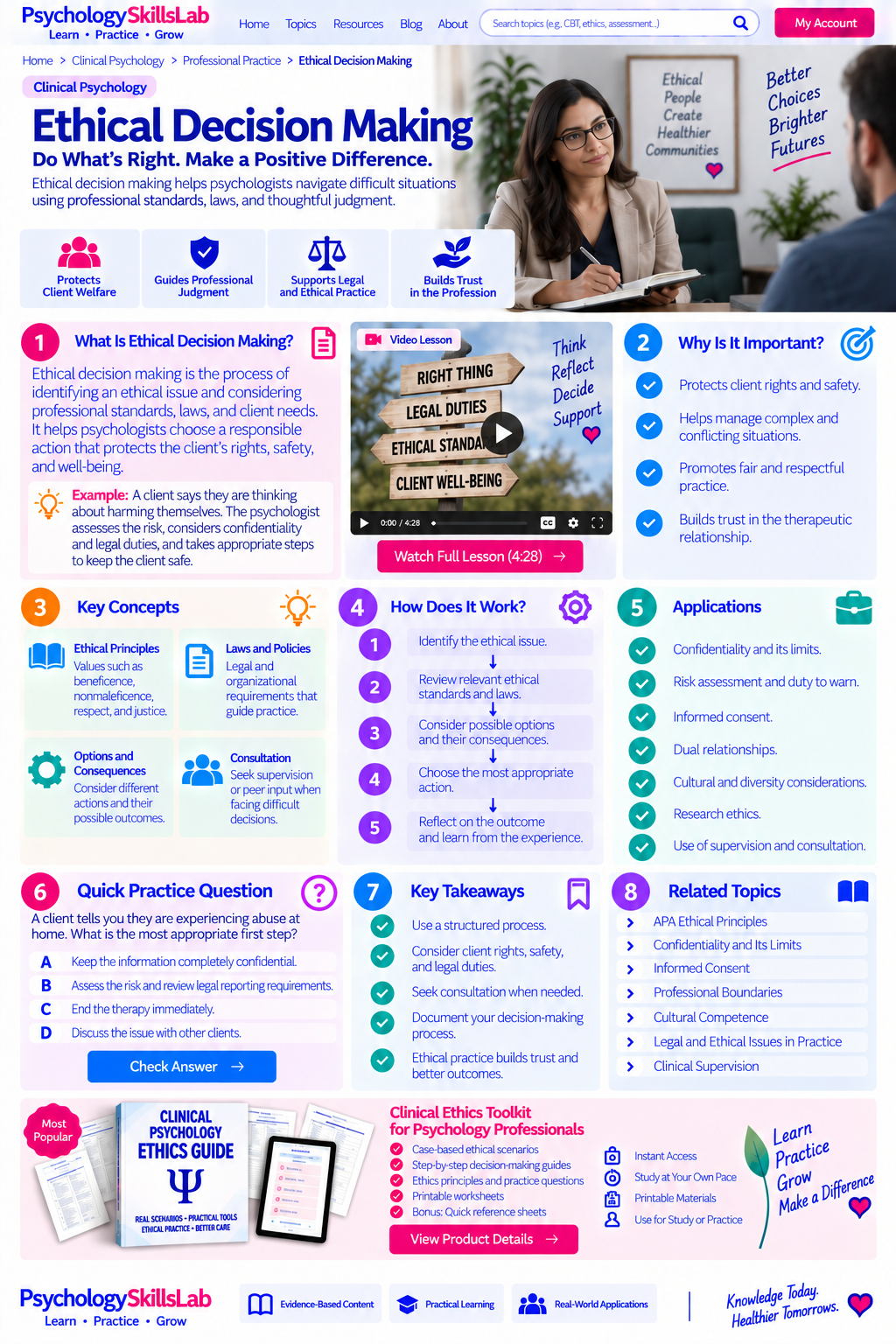
Ethical Decision Making
Do What's Right. Make a Positive Difference.
Ethical decision making is a systematic, reflective process psychologists employ to resolve ambiguous, high-stakes, and conflicting dilemmas by integrating ethical principles, statutory mandates, professional standards, and thoughtful clinical judgment.

"Ethical People Create Healthier Communities."
What Is Ethical Decision Making?
Ethical decision making is a structured analytical protocol utilized when clinical situations present competing obligations, ambiguous guidelines, or legal complexities. It replaces gut reactions with disciplined, defensible moral reasoning.
- check_circle Helps psychologists balance client autonomy, beneficence, legal mandates, and third-party protection.
- check_circle Prevents impulsive reactions during crises through systematic consideration of alternatives.
- check_circle Mandates consulting formal decision-making models, ethics committees, and comprehensive charting.
Think • Reflect • Decide • Support
Doing What Is Right ❤️
Why Is It Important?
- check_circle Protects client rights, safety, and confidentiality in high-stakes crises.
- check_circle Provides a clear path through complex, competing legal and moral dilemmas.
- check_circle Minimizes clinical malpractice risk and demonstrates professional standard of care.
- check_circle Strengthens public trust and integrity in psychological treatment.
Key Concepts
Ethical Principles
Foundational values: beneficence, nonmaleficence, justice, fidelity, and autonomy.
Laws & Regulations
State licensing rules, mandatory reporting statutes, and HIPAA regulations.
Options & Consequences
Weighing short- and long-term impacts of each potential course of action.
Consultation
Actively seeking peer review, supervision, and ethics committee guidance.
How Does It Work?
Identify the ethical dilemma and recognize competing interests.
Review applicable ethical codes, statutory laws, and clinic policies.
Generate alternative options and project short/long-term outcomes.
Choose the most defensible course of action, document, and evaluate.
High-Stakes Ethical Dilemmas
Duty to Protect & Warn
Managing threats of violence or imminent self-harm with least restrictive care.
Mandated Abuse Reporting
Navigating statutory obligations when child or elder abuse is suspected.
Boundary Crossings
Assessing dual relationships, gift acceptance, and overlapping roles.
Cultural Conflicts
Synthesizing standard ethics with diverse cultural and religious worldviews.
Simple Example
A client states they recently learned their teenage daughter is being sexually abused by a relative, but begs the psychologist not to report it to authorities.
The psychologist applies an ethical decision-making model: recognizing child abuse reporting is a non-negotiable statutory mandate, explains this transparently to the client, and supports them collaboratively through making the child welfare report.
Applications
- check_circle Outpatient private practice and acute psychiatric hospital settings
- check_circle Forensic evaluations, custody disputes, and court-mandated treatment
- check_circle University institutional review boards (IRBs) and scientific research
- check_circle Hospital clinical ethics committees and organizational leadership
Benefits & Limitations
- check Replaces subjective emotion with systematic, defensible moral reasoning.
- check Demonstrates standard-of-care adherence during legal or board scrutiny.
- check Promotes collaborative, transparent resolutions with clients.
- close Can be time-intensive during rapid psychiatric emergencies.
- close Different decision-making models can occasionally propose divergent paths.
- close No model eliminates all psychological distress or difficulty in dilemmas.
Key Takeaways
Free Practice Question
6 High-Yield Exam Simulation Questions
What is universally recognized as the essential first step in formal ethical decision-making models (e.g., Corey, Fisher, or Knapp)?
Accurately defining the dilemma and disentangling ethical principles from legal statutes is required before generating realistic solutions.
When a direct conflict occurs between an ethical standard and a mandatory state law, what does the APA Ethics Code instruct psychologists to do?
Under APA Standard 1.02, psychologists clarify the conflict and take reasonable steps to adhere to the code while complying with governing legal authority.
Why is formal peer consultation so strongly emphasized in ethical decision-making protocols?
Consulting trusted peers prevents confirmation bias, brings diverse clinical expertise to light, and proves the clinician acted prudently.
In an ethical dilemma, after generating multiple potential courses of action, what is the next critical step?
Systematically weighing outcomes helps clinicians identify which solution maximizes client welfare, minimizes harm, and complies with legal standards.
Why is meticulous, real-time documentation of the ethical decision-making process indispensable?
If an ethics complaint or lawsuit arises, contemporaneous documentation demonstrating that the clinician identified risks, consulted peers, and weighed codes protects against malpractice claims.
A client tells you they are experiencing ongoing physical domestic violence at home. What is the most appropriate first step in ethical decision making?
Immediate safety assessment, understanding jurisdictional adult/domestic reporting statutes, and empowering the client with collaborative safety planning is the ethical gold standard.
Ethical Decision Making Practice Toolkit
Knowledge Today. Healthier Tomorrows. ❤️