
Clinical Supervision — Official Full Visual Infographic
High-resolution study sheet and visual guide
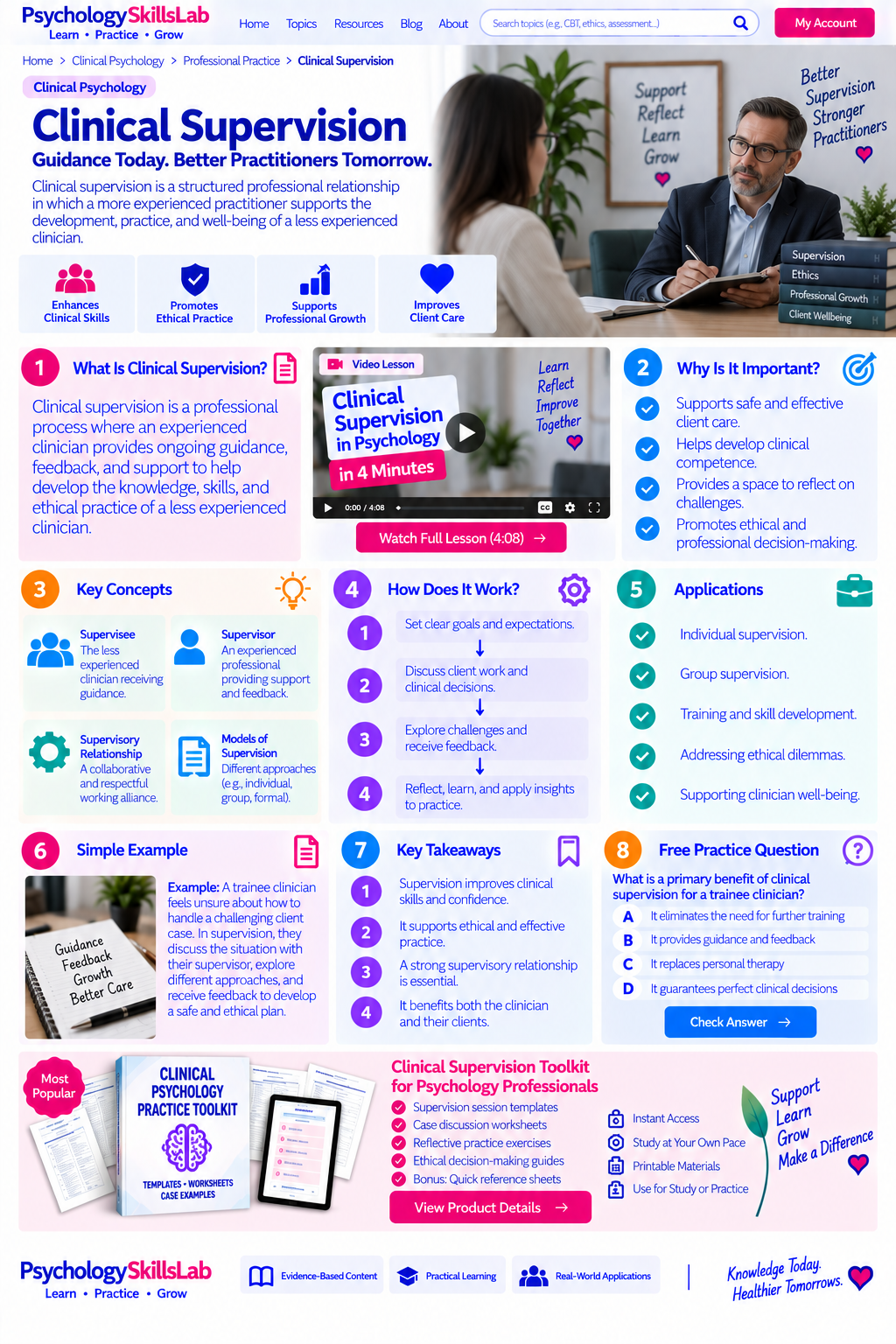
Clinical Supervision
Guidance Today. Better Practitioners Tomorrow.
Clinical supervision is an intensive, interpersonally focused, one-to-one professional relationship in which an experienced supervisor oversees and enhances the competence, ethics, and emotional well-being of a trainee clinician.

"Support. Reflect. Learn. Grow."
What Is Clinical Supervision?
Clinical supervision is a distinct professional practice where an experienced psychologist provides structured guidance, feedback, and evaluative oversight to develop a trainee's clinical competence, ethical vigilance, and therapeutic skill.
- check_circle Acts as the essential gatekeeping mechanism that protects the public from unqualified practice.
- check_circle Combines case formulation, skills coaching, ethical analysis, and countertransference exploration.
- check_circle Involves formal legal vicarious liability (respondeat superior) for client safety.
Clinical Supervision in Psychology in 4 Minutes
Learn • Reflect • Improve Together ❤️
Why Is It Important?
- check_circle Safeguards client welfare by providing an experienced safety net for emerging clinicians.
- check_circle Accelerates trainee diagnostic acumen, intervention mastery, and clinical confidence.
- check_circle Offers a safe, confidential sanctuary to process difficult countertransference and burnout.
- check_circle Maintains rigorous ethical gatekeeping for psychology licensing boards.
Key Concepts
Supervisee
The emerging practitioner receiving ongoing clinical mentorship and evaluation.
Supervisor
The licensed clinician with legal and ethical oversight responsibility.
Supervisory Alliance
A collaborative, safe, and mutually respectful working partnership.
Supervision Models
Developmental (e.g. Stoltenberg IDM), CBT, or integrative supervision models.
How Does It Work?
Establish a formal written supervision contract with clear goals and metrics.
Review active client cases, recordings, and documentation weekly.
Explore clinical challenges, address ethical questions, and give feedback.
Evaluate trainee competence and reflect on ongoing professional growth.
Supervisory Modalities & Formats
Individual Supervision
One-on-one intensive clinical coaching and case review.
Group Supervision
Collaborative peer case consultation and multidimensional feedback.
Live Observation & Video
Direct observation of therapy sessions with immediate debriefing.
Gatekeeping & Licensure
Formal competency tracking for pre-doctoral internships and postdocs.
Simple Example
A psychology intern feels overwhelmed when a borderline personality client expresses intense rage during sessions.
In weekly supervision, the supervisor helps the intern process countertransference, reinforces dialectical behavioral de-escalation skills, and creates a clear crisis management plan.
Applications
- check_circle University doctoral psychology clinics and practicum sites
- check_circle APA-accredited predoctoral internship programs
- check_circle Postdoctoral residency fellowships for licensure
- check_circle Ongoing peer consultation for experienced licensed psychologists
Benefits & Limitations
- check Guarantees optimal, protected clinical care for clients seen by trainees.
- check Fosters deep reflective capacity and rapid professional maturation.
- check Prevents emotional exhaustion, isolation, and vicarious traumatization.
- close Power differentials can sometimes inhibit honest trainee disclosures.
- close Poor supervisory chemistry or lack of feedback can stunt growth.
- close Supervisors carry heavy vicarious liability for supervisee mistakes.
Key Takeaways
Free Practice Question
6 High-Yield Exam Simulation Questions
What is the primary overarching ethical duty of a clinical supervisor in psychology?
While supervisors foster trainee growth, their ultimate legal and ethical duty is safeguarding the well-being of the clients under the supervisee's care.
Under the legal doctrine of "respondeat superior" (vicarious liability), who carries legal responsibility for clinical negligence by a trainee?
Supervisors have vicarious liability for the clinical work of their supervisees within the scope of supervision, meaning negligent oversight can hold the supervisor liable.
What must a client always be told during the informed consent process when being treated by a trainee or intern?
APA Standard 10.01(c) requires informing clients that the therapist is in training and under supervision, providing the supervisor's name and legal responsibility.
A clinical supervisor realizes that their supervisee is having severe marital problems and offers to conduct ongoing couples therapy for them. This is:
Providing psychotherapy to one's supervisee creates an unethical dual relationship, corrupting the supervisor's evaluative objectivity and violating power boundaries.
What is the purpose of establishing a written supervision contract at the start of a clinical placement?
A formal supervisory agreement sets mutual expectations, clarifies how performance will be graded, and details crisis protocols, minimizing misunderstandings.
If a supervisor notices that a supervisee is chronically arriving late, missing notes, and showing signs of severe burnout, what should the supervisor do?
Responsible supervisors fulfill a gatekeeping role by identifying impairment early, offering developmental remediation, adjusting workload, and protecting clients.
Clinical Supervision Practice Toolkit
Knowledge Today. Healthier Tomorrows. ❤️