
Documentation Standards — Official Full Visual Infographic
High-resolution study sheet and visual guide
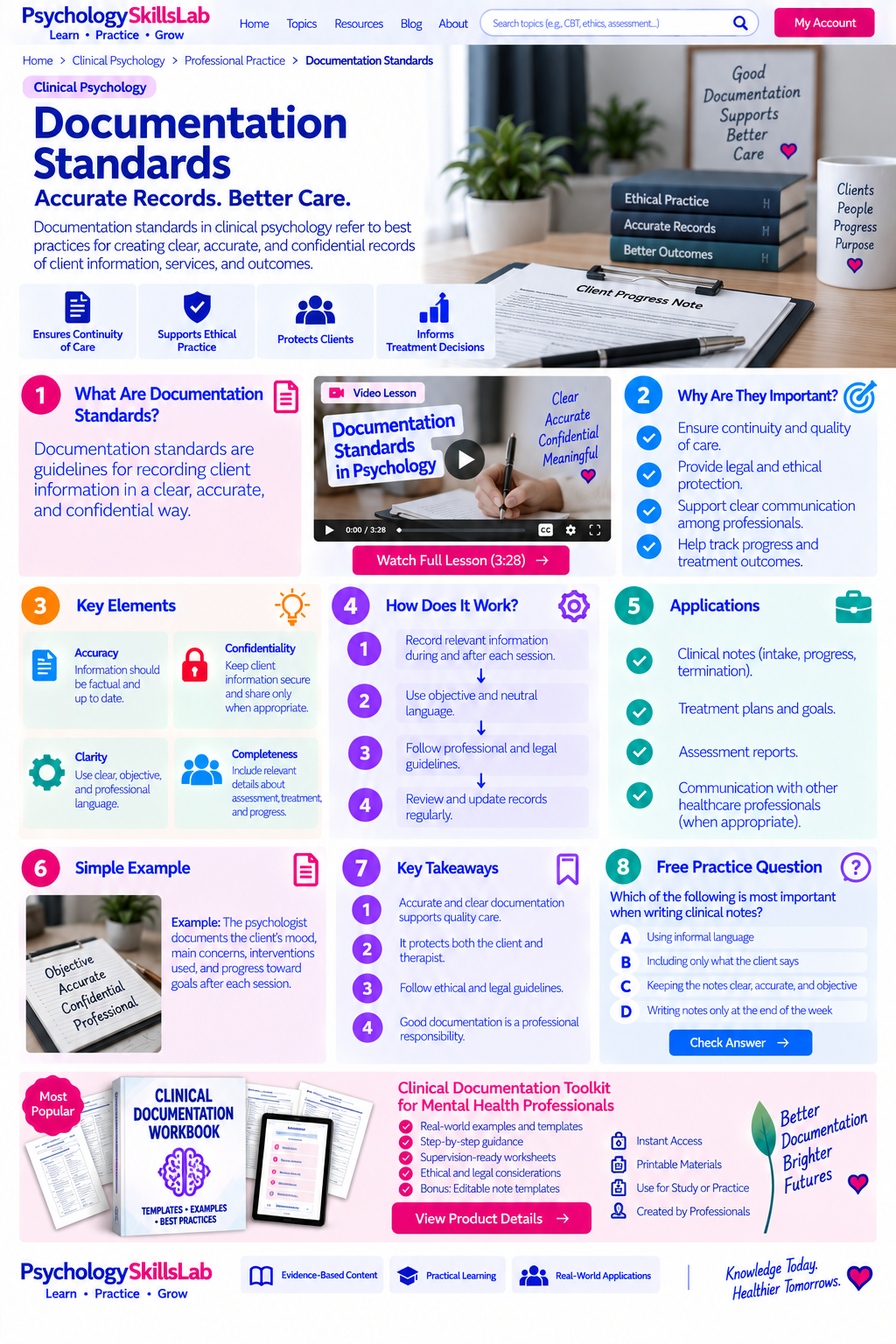
Documentation Standards
Accurate Records. Better Care.
Documentation standards in clinical psychology represent the professional, ethical, and legal guidelines for maintaining clear, objective, accurate, and secure records of client care, assessment findings, and treatment progress.

"Good Documentation Supports Better Care."
What Are Documentation Standards?
Documentation standards are the formal rules that regulate how psychological encounters, assessment results, and clinical decisions are recorded. Notes serve as both an ongoing clinical tool and a permanent medical-legal record.
- check_circle Mandates factual, objective observations separated from clinical interpretations.
- check_circle Ensures seamless continuity of care if another provider must assume treatment.
- check_circle Provides essential legal and ethical protection for both client and psychologist.
Documentation Standards in Psychology
Clear • Accurate • Confidential • Meaningful ❤️
Why Are They Important?
- check_circle Guarantees high continuity and quality of clinical care over time.
- check_circle Provides indispensable legal and regulatory protection during audits or disputes.
- check_circle Facilitates transparent communication among multidisciplinary healthcare teams.
- check_circle Accurately tracks client symptom trajectory, interventions, and measurable outcomes.
Key Elements
Accuracy
Recording factual data, session dates, times, and verifiable observations.
Confidentiality
Securing records from unauthorized eyes under strict privacy rules.
Clarity & Objectivity
Using professional, neutral language free of bias or emotional slurs.
Completeness
Including risk assessments, treatment plans, and intervention details.
How Does It Work?
Record key details promptly during or immediately following each encounter.
Apply standardized clinical formats like SOAP or DAP notes consistently.
Follow statutory retention mandates and electronic data security guidelines.
Review, update, and sign notes in the permanent health record system.
Core Documentation Records
Progress & Intake Notes
SOAP/DAP notes documenting mental status, goals, and response to treatment.
Treatment & Safety Plans
Formal measurable goals, risk mitigation plans, and discharge summaries.
Assessment Reports
Comprehensive psychological evaluations, test scores, and interpretations.
Inter-Professional Records
Collaborative summaries for physicians, psychiatrists, and schools.
Simple Example
A psychologist conducts a 50-minute cognitive therapy session with a client presenting with major depression.
The clinician writes a structured SOAP note: documenting subjective mood scores (S), observed affect and motor activity (O), clinical analysis of cognitive distortions (A), and homework exposure tasks (P) within 24 hours.
Applications
- check_circle Private outpatient psychology practices
- check_circle Hospital inpatient and psychiatric emergency wards
- check_circle Forensic evaluations and disability documentation
- check_circle Insurance billing, managed care, and audit compliance
Benefits & Limitations
- check Establishes defensible proof of standard-of-care clinical practice.
- check Empowers colleagues to seamlessly continue treatment in emergencies.
- check Demonstrates client progress clearly to justify ongoing insurance funding.
- close Time-consuming administrative overhead can contribute to burnout.
- close Overly extensive notes can inadvertently increase privacy breach risks.
- close Poorly worded subjective notes can be misinterpreted in legal proceedings.
Key Takeaways
Free Practice Question
6 High-Yield Exam Simulation Questions
Which of the following is the most important clinical guideline when writing progress notes in a client's chart?
Clinical notes are official medical-legal documents. They must remain objective, professional, timely, and focused on verifiable symptoms and evidence-based interventions.
In the SOAP note documentation format, what does the "O" stand for and contain?
Objective (O) captures observable, empirical clinical data such as speech rate, psychomotor activity, affect, orientation, and standardized screening scores.
If an error is discovered in a physical, paper clinical record, what is the standard correction protocol?
Proper medical-legal charting requires transparency. Drawing a single strike-through line preserves the original entry while adding the correction with date and initials.
According to APA Record Keeping Guidelines, how long should a psychologist typically retain adult client records following termination?
APA guidelines recommend retaining full adult records for at least 7 years post-termination, with minor records retained for 7 years or until 3 years after the minor reaches adulthood.
Why must suicide risk assessments and safety plans be documented in extensive, detailed detail?
In high-risk encounters, meticulous documentation of risk factors, protective factors, clinical reasoning, and concrete safety plans demonstrates adherence to the standard of care.
What is the key difference between general "psychotherapy notes" and the general "medical record" under HIPAA?
Under HIPAA, private psychotherapy process notes kept separate from the formal medical record enjoy heightened privacy and are protected from standard release mandates.
Clinical Documentation Toolkit for Mental Health Professionals
Knowledge Today. Healthier Tomorrows. ❤️