
Cultural Competence — Official Full Visual Infographic
High-resolution study sheet and visual guide
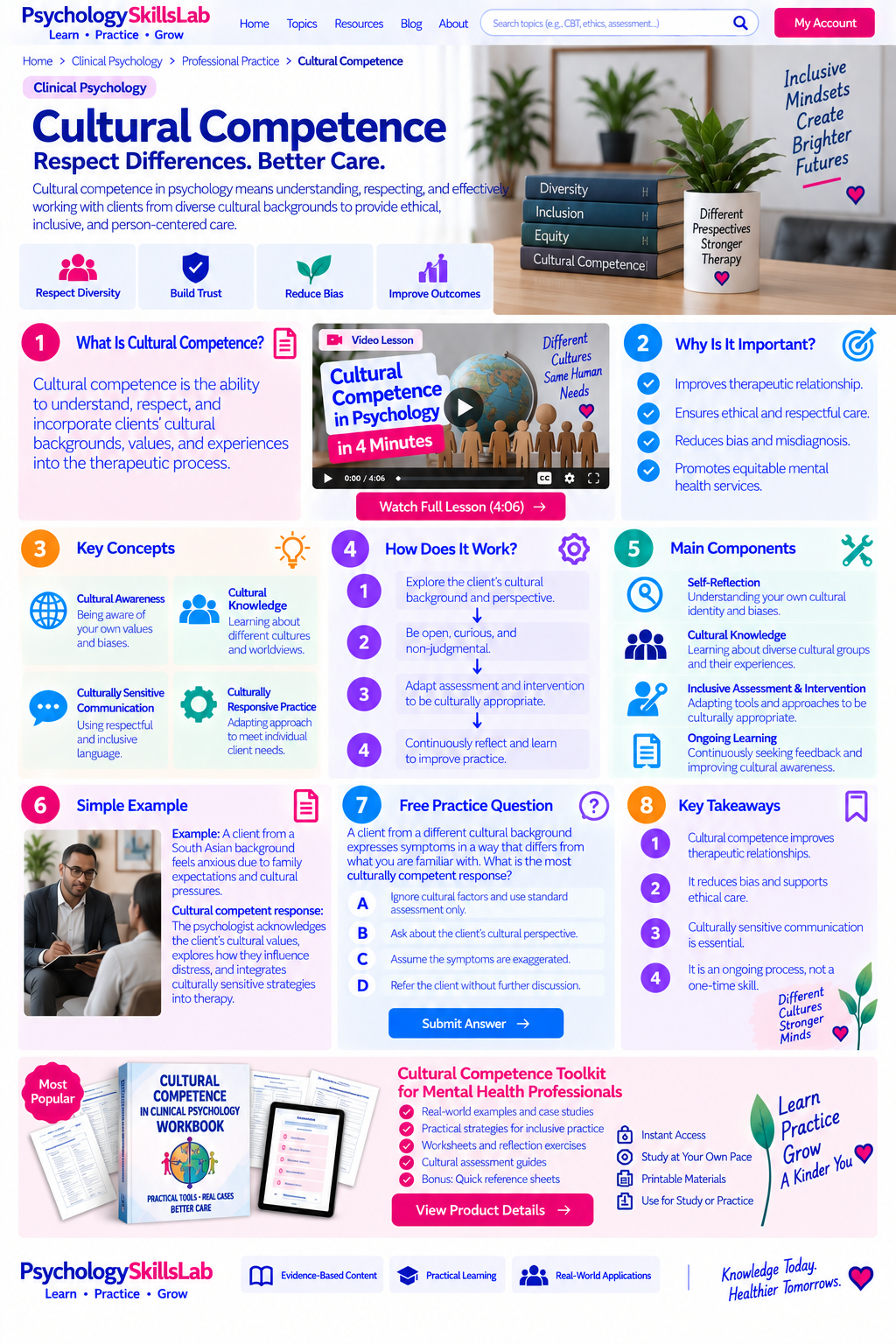
Cultural Competence
Respect Differences. Better Care.
Cultural competence in psychology is the ability to understand, appreciate, and effectively interact with clients across diverse racial, ethnic, religious, gender, and socio-economic backgrounds to provide equitable, person-centered care.
"Different Perspectives Stronger Therapy."
What Is Cultural Competence?
Cultural competence is an ethical mandate combining self-awareness, cultural knowledge, and cross-cultural clinical skills. It ensures psychological interventions reflect and respect the client's cultural worldview, values, and lived experiences.
- check_circle Requires critical examination of the psychologist's own cultural lens and implicit assumptions.
- check_circle Mandates adapting assessment instruments, diagnostic formulations, and therapy models.
- check_circle Embodies cultural humility—a lifelong commitment to learning, self-critique, and openness.
Cultural Competence in Psychology in 4 Minutes
Different Cultures Same Human Needs ❤️
Why Is It Important?
- check_circle Significantly enhances the therapeutic alliance with marginalized and diverse clients.
- check_circle Directly reduces diagnostic bias, pathologizing differences, and misdiagnosis.
- check_circle Ensures ethical, dignified, and culturally responsive psychological care.
- check_circle Promotes social justice, healthcare equity, and community accessibility.
Key Concepts
Cultural Awareness
Recognizing one's own cultural identity, privileges, and blind spots.
Cultural Knowledge
Gaining deep understanding of diverse worldviews and traditions.
Sensitive Dialogue
Employing inclusive, validating, and respectful language.
Responsive Practice
Adapting clinical modalities to align with client cultural needs.
How Does It Work?
Explore the client's cultural background, identity, and personal worldview.
Maintain an open, curious, respectful, and non-judgmental stance.
Adapt standardized assessment and intervention to fit cultural realities.
Engage in continuous self-reflection, supervision, and lifelong learning.
Main Components
Self-Reflection
Unpacking personal cultural biases, stereotypes, and privileges.
Cultural Knowledge
Understanding historical trauma, systemic racism, and community values.
Adapted Interventions
Modifying evidence-based treatments for cultural resonance.
Lifelong Learning
Ongoing cultural competence training and humility practice.
Simple Example
A second-generation South Asian student experiences severe anxiety due to intense family academic expectations and collectivistic obligations.
The psychologist acknowledges the values of family honor and interdependent self-construal rather than pathologizing it as enmeshment, developing culturally synthesized coping strategies.
Applications
- check_circle Community mental health and cross-cultural counseling clinics
- check_circle Psychological assessment using culturally validated instruments
- check_circle Refugee, immigrant, and minority population mental healthcare
- check_circle Hospital and interdisciplinary medical team consultations
Benefits & Limitations
- check Greatly reduces therapy dropout rates among diverse populations.
- check Prevents harmful misattribution of cultural norms as pathology.
- check Elevates patient trust, engagement, and lasting positive change.
- close Risk of stereotyping if group knowledge is applied rigidly to individuals.
- close Clinicians cannot know everything about every cultural group.
- close Requires vulnerability to acknowledge systemic privileges and gaps.
Key Takeaways
Free Practice Question
6 High-Yield Exam Simulation Questions
What is considered the foundational first step in developing genuine cultural competence as a psychologist?
Competence starts with self-awareness: recognizing that one's own worldview is culturally conditioned prevents imposing unexamined values upon clients.
A client from an indigenous community explains their depressive symptoms in terms of a loss of spiritual harmony. What is the most culturally competent response?
Validating idioms of distress and cultural frameworks honors the client's lived reality and prevents misdiagnosing normal cultural expressions as psychosis.
What is the primary clinical purpose of the DSM-5 Cultural Formulation Interview (CFI)?
The CFI is a standardized interview tool that helps clinicians elicit the client's understanding of their problem, support systems, and cultural expectations of care.
When administering standardized psychological tests to culturally and linguistically diverse clients, psychologists must:
Using tests normed only on majority populations can lead to invalid conclusions, discrimination, and inaccurate diagnostic labeling.
How does "Cultural Humility" differ from traditional "Cultural Competence"?
Humility emphasizes ongoing self-critique and egalitarian partnership, acknowledging that the client is the ultimate expert on their own lived experience.
In collectivist cultures, decisions are frequently made with input from extended family elders. Viewing this as "lack of independence" or "pathological enmeshment" is an example of:
Evaluating collectivist family solidarity through an exclusively individualistic Western lens pathologizes healthy, normative cultural functioning.
Cultural Competence Toolkit for Mental Health Professionals
Knowledge Today. Healthier Tomorrows. ❤️