
Boundaries — Official Full Visual Infographic
High-resolution study sheet and visual guide
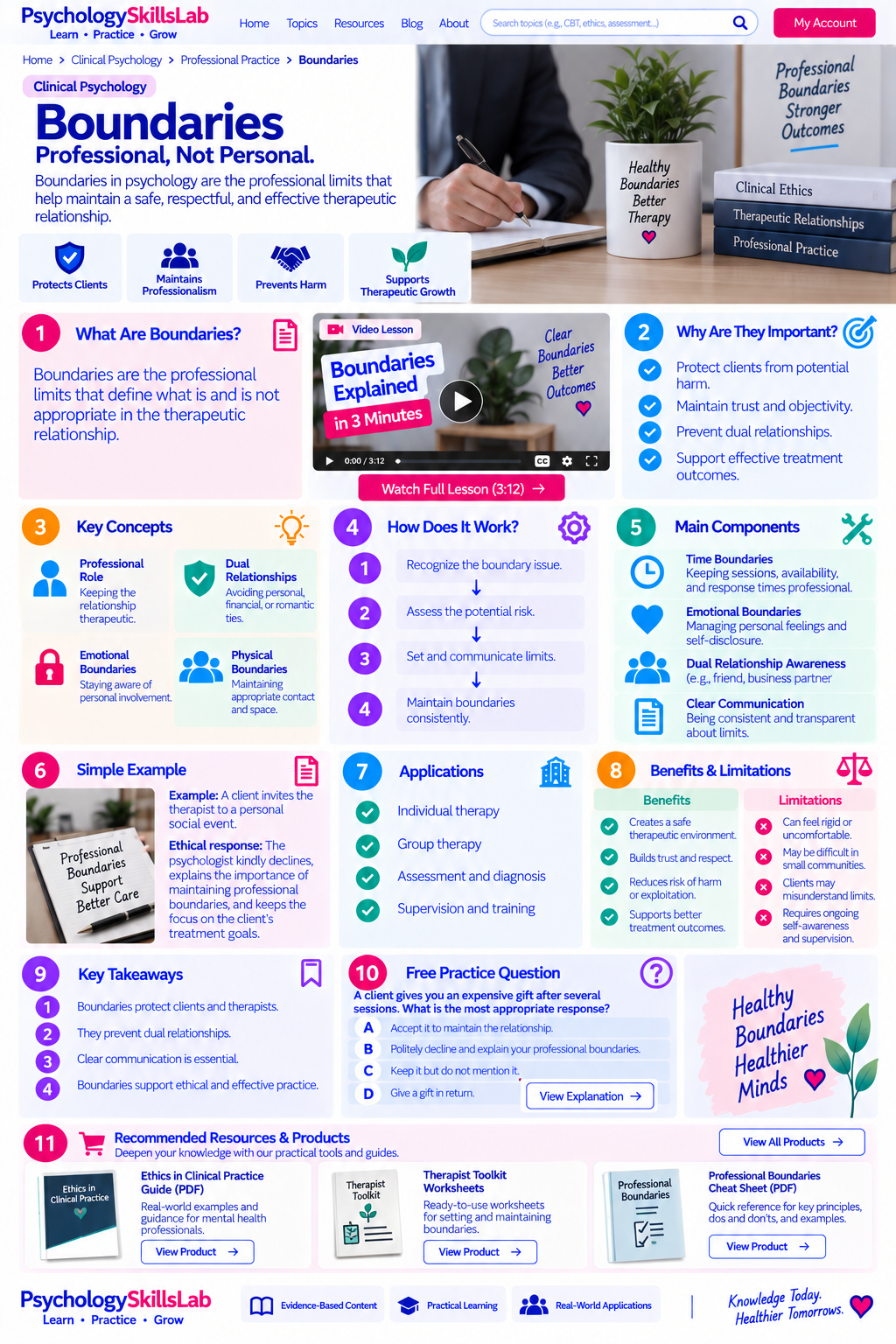
Boundaries
Professional, Not Personal.
Boundaries in psychology define the professional parameters that protect the safety, respect, and objectivity of the therapeutic alliance. Clear limits prevent exploitation, maintain focus on the client, and ensure ethical practice.

"Healthy Boundaries Better Therapy."
What Are Boundaries?
Boundaries are the ethical, physical, emotional, and relational frameworks that define what is and is not acceptable within psychotherapy. They establish a secure holding environment that protects clients from confusion and harm.
- check_circle Distinguishes between therapeutic caring and personal, social, or romantic relationships.
- check_circle Encompasses session start/end times, communication channels, fees, and physical space.
- check_circle Requires careful differentiation between benign boundary crossings and harmful boundary violations.
Boundaries Explained in 3 Minutes
Clear Boundaries Better Outcomes ❤️
Why Are They Important?
- check_circle Shields vulnerable clients from exploitation, dependency, and manipulation.
- check_circle Preserves the clinician's objectivity, emotional neutrality, and clinical clarity.
- check_circle Prevents complex dual relationships that inevitably complicate care.
- check_circle Directly fosters safe, predictable conditions needed for deep psychological healing.
Key Concepts
Professional Role
Remaining steadfastly in the role of therapist, not personal friend.
Dual Relationships
Avoiding concurrent business, financial, or social entanglements.
Emotional Limits
Monitoring self-disclosure and countertransference reactions.
Physical Boundaries
Maintaining appropriate professional distance and setting structure.
How Does It Work?
Recognize emerging boundary dilemmas or unusual client requests.
Assess potential risk, exploitation, or damage to objectivity.
Set and communicate limits kindly, clearly, and therapeutically.
Maintain boundaries consistently and seek supervision when challenged.
Main Components
Time Boundaries
Strict adherence to session duration and response intervals.
Emotional Boundaries
Judicious, purposeful self-disclosure solely for client benefit.
Dual Relationship Awareness
Proactively managing unavoidable community overlaps.
Clear Policies
Written clinic policies on gifts, social media, and after-hours contact.
Simple Example
A wealthy therapy client invites their psychologist to attend their weekend family wedding and offer a personal toast.
The psychologist kindly declines, explains that maintaining a professional relationship preserves therapeutic focus, and processes the client's feelings with empathy during session.
Applications
- check_circle Individual, group, and family therapy settings
- check_circle Supervisory and mentorship relationships
- check_circle Rural and close-knit community practices
- check_circle Telehealth and digital communications
Benefits & Limitations
- check Guarantees a safe, predictable, and focused healing container.
- check Builds deep professional trust and mutual respect.
- check Shields both client and therapist from harmful boundary erosion.
- close Can initially feel rigid or emotionally cool to some clients.
- close Challenging to manage in small cultural or rural communities.
- close Demands continuous self-monitoring and clinical supervision.
Key Takeaways
Free Practice Question
6 High-Yield Exam Simulation Questions
A client gives you an expensive gold watch worth $1,500 at the end of several months of therapy. What is the most ethically appropriate response?
Accepting high-value gifts distorts professional boundaries and creates indebtedness. Declining warmly while exploring the underlying meaning upholds ethics.
What differentiates an ethical "boundary crossing" from an unethical "boundary violation"?
A crossing (e.g., attending a client's funeral or brief touch on the arm to console) can be supportive, whereas a violation (e.g., romantic or business ties) exploits the client.
A psychologist in a very small rural town discovers that the only mechanic in town is their psychotherapy client. What is the ethical course of action?
When rural dual relationships are unavoidable, APA ethics allows services provided the clinician actively manages potential conflicts, documents precautions, and protects objectivity.
A therapist receives a Facebook friend request from an active client. How should the therapist manage this digital boundary?
Friending clients on personal social media erodes therapeutic boundaries and exposes private therapist information. Professional social media policies should be clear.
What is the primary guideline regarding clinician self-disclosure during therapy sessions?
Self-disclosure must be client-focused, purposeful, and brief to illuminate a point without burdening the client with the clinician's personal concerns.
Under APA ethical standards, what is the mandatory minimum time that must elapse before a psychologist could even contemplate romantic intimacy with a former client (though strongly discouraged forever)?
APA Standard 10.08 bans sexual intimacies with former clients for at least two years post-termination, placing the burden of proving no exploitation occurred on the psychologist.
Professional Boundaries Toolkit
Deepen your clinical practice with ready-to-use worksheets and guides.
Ethics in Clinical Practice Guide (PDF)
Comprehensive manual on navigating boundary dilemmas and dual relationships.
Therapist Toolkit Worksheets
Ready-to-use client boundary discussion forms and case exercises.
Professional Boundaries Cheat Sheet (PDF)
Quick reference guide covering boundary crossings vs. violations.
Knowledge Today. Healthier Tomorrows. ❤️