
Confidentiality — Official Full Visual Infographic
High-resolution study sheet and visual guide
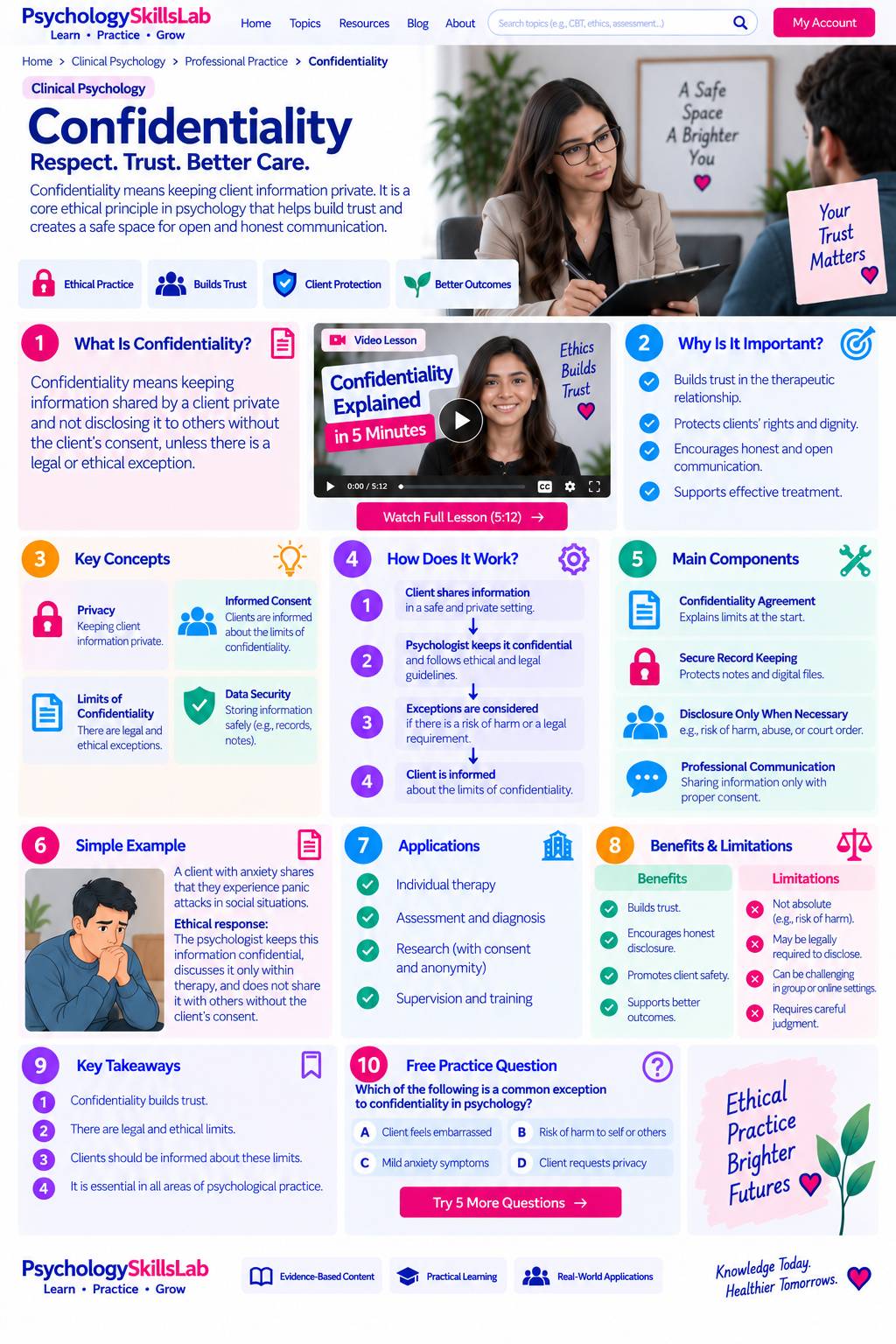
Confidentiality
Respect. Trust. Better Care.
Confidentiality means keeping client information private and secure. It is the cornerstone of psychological treatment that enables clients to speak openly, process vulnerable experiences, and build genuine trust with their clinician.

"A Safe Space. A Brighter You."
What Is Confidentiality?
Confidentiality is an explicit ethical duty and legal obligation prohibiting psychologists from disclosing information shared during treatment without the client's voluntary, informed consent, except under narrow, legally mandated circumstances.
- check_circle Creates an essential environment of psychological safety for emotional honesty and disclosure.
- check_circle Governs physical therapy notes, diagnostic records, electronic health records, and communications.
- check_circle Mandates clear communication of legal exceptions (harm to self/others, child or elder abuse) at intake.
Confidentiality Explained in 5 Minutes
Ethics Builds Trust ❤️
Why Is It Important?
- check_circle Builds deep trust and vulnerability in the therapeutic relationship.
- check_circle Protects clients' constitutional rights, reputation, and personal dignity.
- check_circle Encourages candid, uninhibited disclosure of trauma and emotional struggles.
- check_circle Directly correlates with positive therapeutic adherence and clinical outcomes.
Key Concepts
Privacy
Preserving client disclosures from unauthorized view.
Informed Consent
Clearly explaining privacy limits prior to treatment.
Statutory Limits
Navigating legal exceptions such as child abuse or duty to protect.
Data Security
Storing electronic records behind HIPAA/GDPR-compliant security.
How Does It Work?
Client shares sensitive details in a private, confidential clinical setting.
Psychologist secures all records according to legal and ethical mandates.
Exceptions are evaluated immediately if imminent risk of severe harm arises.
Client is proactively informed of any necessary disclosures or court mandates.
Main Components
Confidentiality Agreement
Written agreement detailing privacy rights and legal limits at intake.
Secure Record Keeping
Double-locked filing and encrypted, password-protected cloud storage.
Mandated Exceptions
Protocols for imminent danger, abuse of minors or elderly, and valid subpoenas.
Professional Communication
Never discussing client cases casually or in public spaces.
Simple Example
A client working in corporate finance reveals during therapy that they experience crippling panic attacks and feelings of deep inadequacy.
The psychologist keeps all disclosures completely confidential, enters objective notes in an encrypted portal, and does not discuss the case with anyone without explicit written release.
Applications
- check_circle Individual outpatient and inpatient psychotherapy
- check_circle Psychodiagnostic testing and personality assessments
- check_circle Clinical research with de-identified and anonymous data
- check_circle Formal supervision and peer consultation
Benefits & Limitations
- check Builds foundational trust and psychological safety.
- check Encourages genuine exploration of hidden emotional pain.
- check Protects client employment, reputation, and civil liberties.
- close Confidentiality is not absolute (duty to protect, mandated abuse reporting).
- close Court subpoenas and judicial orders may compel selective testimony.
- close Managing privacy in group, couples, and family therapy is inherently complex.
Key Takeaways
Free Practice Question
6 High-Yield Exam Simulation Questions
Which of the following scenarios represents a mandatory, non-negotiable legal exception to confidentiality in psychology?
Under the landmark Tarasoff ruling and statutory duties to protect/warn, imminent credible threats against identifiable persons require clinicians to take protective actions.
When treating an adolescent minor, who legally holds the privilege of confidentiality in most jurisdictions?
Parents/guardians typically hold legal rights to records, though effective clinicians establish clear upfront agreements that routine disclosures remain confidential to foster trust.
A client's spouse calls the therapy clinic demanding to know whether their partner attended their appointment today. The therapist should:
Even acknowledging that someone is a client is an unauthorized disclosure of protected health information unless an explicit authorization is in place.
In group therapy, what crucial limit of confidentiality must the psychologist communicate to all participants?
While the psychologist is bound by law and ethics, peer group members are not licensed professionals and cannot be legally compelled to keep secrets, necessitating clear group contracts.
What is the standard protocol when a psychologist receives a subpoena for client therapy records from an opposing attorney?
A subpoena is not the same as a court order signed by a judge. The clinician must assert therapist-client privilege until the client waives it or a judge compels disclosure.
Under modern electronic record standards (HIPAA/GDPR), psychological therapy notes stored on a laptop must be:
Digital data security mandates robust encryption, multi-factor authentication, and secure offsite backups to safeguard sensitive health information from breaches.
Confidentiality & Clinical Records Toolkit
Knowledge Today. Healthier Tomorrows. ❤️