
Professional Ethics — Official Full Visual Infographic
High-resolution study sheet and visual guide
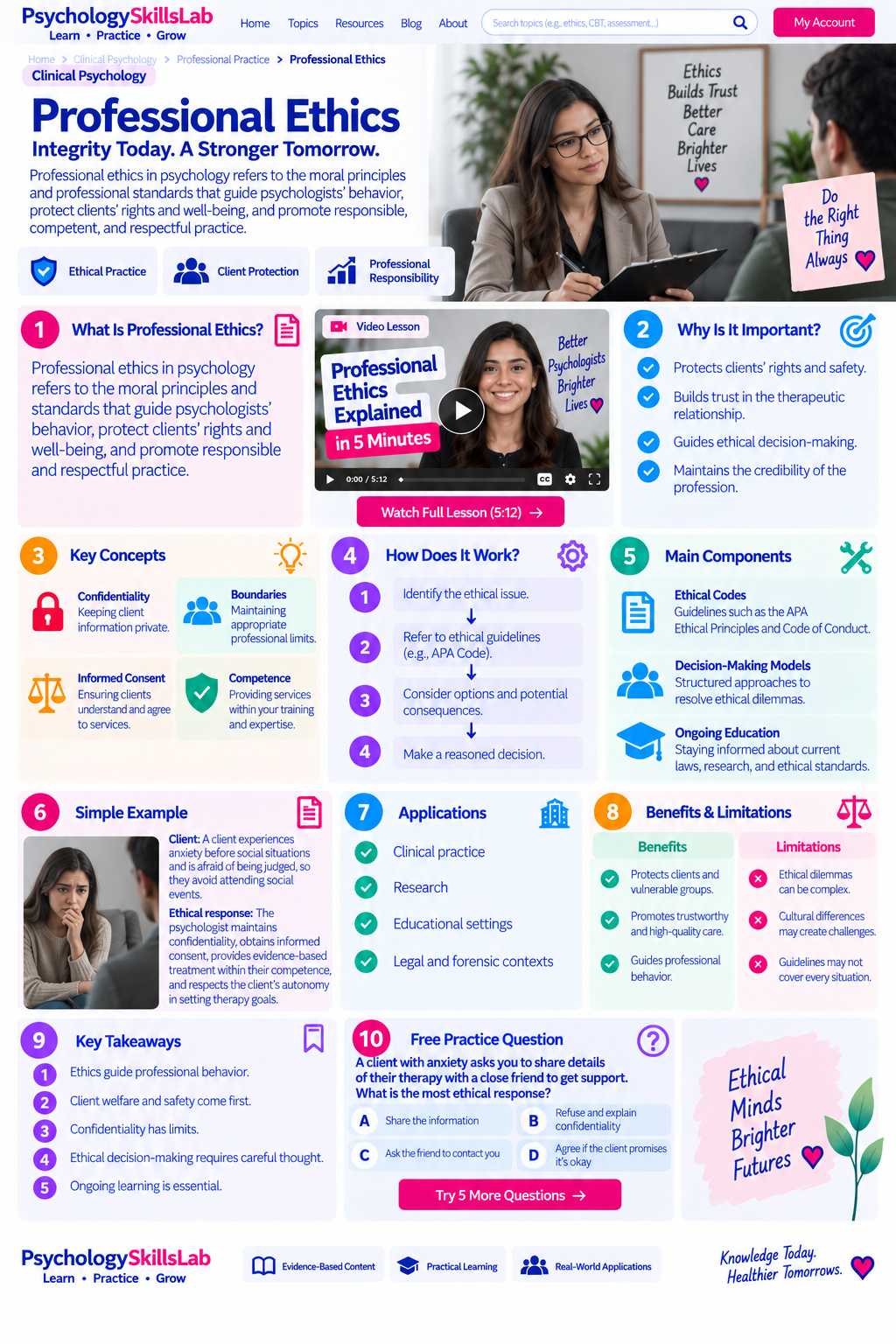
Professional Ethics
Integrity Today. A Stronger Tomorrow.
Professional ethics in psychology refers to the moral principles, standards of conduct, and legal obligations that guide psychologists' behavior. These standards protect clients' rights and safety, safeguard public welfare, and promote competent, accountable, and respectful clinical practice across all healthcare environments.

"Ethics Builds Trust. Better Care. Brighter Lives."
What Is Professional Ethics?
Professional ethics in psychology represents the formal codification of moral standards, professional duties, and regulatory mandates that govern clinical judgment and behavior. Rooted in foundational human rights and scientific discipline, ethics establish clear accountability between clinicians and society.
- check_circle Provides an authoritative framework to resolve difficult clinical decisions and competing duties.
- check_circle Mandates non-maleficence, client safety, informed agreement, and confidentiality protections.
- check_circle Requires practicing strictly within boundaries of empirical education, training, and competence.
Professional Ethics Explained in 5 Minutes
Better Psychologists • Brighter Lives ❤️
Why Is It Important?
- check_circle Protects clients' legal rights, psychological well-being, and personal dignity.
- check_circle Builds strong therapeutic trust and rapport essential for positive outcomes.
- check_circle Guides structured, objective decision-making in complex and high-risk dilemmas.
- check_circle Maintains the professional reputation, accountability, and credibility of psychology.
Key Concepts
Confidentiality
Safeguarding client information and private records.
Boundaries
Maintaining appropriate professional and emotional limits.
Informed Consent
Ensuring clients fully comprehend and agree to interventions.
Competence
Providing services strictly within certified training and skill.
How Does It Work?
Identify the ethical, clinical, or legal issue in the client situation.
Refer to ethical guidelines (e.g., APA Ethics Code) and jurisdictional laws.
Consider all available options, consultation, and potential consequences.
Make a reasoned, documented decision that prioritizes client welfare.
Main Components
Ethical Codes
Official guidelines such as APA Ethical Principles and Code of Conduct.
Decision-Making Models
Systematic, step-by-step frameworks to analyze complex clinical conflicts.
Ongoing Education
Continuous professional development, ethics training, and legal updates.
Simple Example
A client experiences severe panic attacks before social events and is terrified of judgment, avoiding university classes and interpersonal activities.
The psychologist maintains strict confidentiality, explains treatment limits via informed consent, provides evidence-based CBT within their area of competence, and collaboratively empowers the client to direct their own goals.
Applications
- check_circle Clinical practice (outpatient, inpatient, community mental health)
- check_circle Scientific research, clinical trials, and university studies
- check_circle Educational settings, supervision, and trainee mentoring
- check_circle Legal, forensic, and statutory court evaluations
Benefits & Limitations
- check Protects clients and vulnerable populations from exploitation.
- check Promotes trustworthy, consistent, and evidence-based care.
- check Guides clear professional boundaries across all clinical duties.
- close Ethical dilemmas can be deeply nuanced and ambiguous.
- close Cultural and societal worldviews may conflict with rigid codes.
- close General principles cannot predict every unique client circumstance.
Key Takeaways
Free Practice Question
6 High-Yield Exam Simulation Questions
A client with severe social anxiety asks you to share details of their therapy sessions with a close personal friend so the friend can support them. What is the most ethical response?
Confidentiality cannot be waived informally. Disclosing clinical records or session notes requires formal written authorization, and explaining the boundaries safeguards the therapeutic alliance.
Which ethical principle emphasizes a psychologist's primary obligation to "do no harm" to their clients?
Nonmaleficence is the foundational duty to refrain from inflicting physical or psychological harm, avoiding exploitation, and minimizing unintended negative consequences.
When faced with a complex ethical dilemma that is not explicitly addressed in the APA Ethics Code, what should a psychologist do first?
Ethical decision-making models, statutory reviews, and peer supervision provide objectivity and establish that the clinician acted with reasonable professional judgment.
A psychologist is offered free legal advice by an attorney client in exchange for ongoing psychotherapy sessions. What does this arrangement represent?
Bartering psychological services for professional goods or services carries significant potential for conflict of interest, boundary erosion, and clinical exploitation.
Practicing strictly within one's boundaries of competence requires that psychologists:
Competence requires formal education, clinical training, supervised experience, and consultation before independently administering specialized psychological services.
What must a psychologist do if their personal distress or life crises begin to impair their clinical judgment and professional effectiveness?
When physical or mental health compromises clinical objectivity, psychologists are ethically bound to restrict their caseload and seek independent help to prevent harm.
Clinical Ethics Toolkit for Psychology Professionals
Knowledge Today. Healthier Tomorrows. ❤️